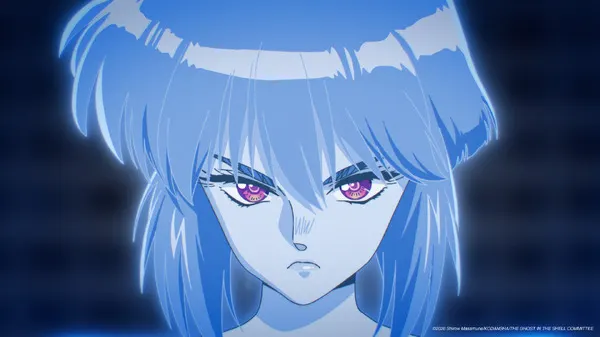
A Sniper Round in the First Three Minutes
Animation studio Science SARU's take on Masamune Shirow's 1989 manga, published by Kodansha under its KC Deluxe imprint, has spent the summer doing something no previous screen version bothered with: sticking close to the book. The premise is unchanged. In a near future where information networks and cyborg technology are highly advanced and people are wired directly into the net, full-body cyborg Motoko Kusanagi leads a special operations unit that takes on cyber-crime. The finale is where that fidelity came due.
The episode opens on the standoff left hanging in episode 9, with Motoko holding the face sculptor she had abducted and trying to get clear. A flock of water birds breaks from the water, and the police sniper team fires as if it had been waiting for exactly that cue. Roughly three minutes in, a rifle round removes everything above Motoko's neck. Then the opening plays. King Gnu's "GO GHOST" ends, and the show replays the hit.
Batou's voice arrives from a distance, grumbling about young cops getting rough, and Motoko answers him. She lost the shell, not the ghost. Reduced to a brain in a case, she escapes with Batou's help, though Japanese viewers spent the next stretch wondering whether she had let the shot land on purpose, according to Japanese anime news site Anime Anime's roundup of the finale's live reactions.
The spare body Batou takes her to, stashed in a locker at a defunct research facility, has gone moldy and rotted inside its aluminum alloy casing. Then the door opens. A salvage crew, about 18 strong, piles in to strip the place of anything usable. Batou counts three heavyweight-class bodies among them, tells Motoko to start thinking of a thank-you note because what comes next legally counts as murder, and goes hunting. Motoko drops into shutdown mode to conserve power.
The Puppet Master Makes an Offer
Shutdown mode is not as private as advertised. A voice reaches her there, and she recognizes the faint but enormous network presence as the Puppet Master (Kikuko Inoue), who she had assumed was gone for good. What follows is the sequence longtime readers have been waiting nine weeks for, and it is dense: the Puppet Master asks how a network avoids catastrophe and holds a stable equilibrium, Motoko offers two answers, and the conversation slides from information theory into biology and then into cosmology.
Japanese viewers, who had already been flattened by episode 7, mostly gave up. Comments ran from "I don't get it" to "a Zen scene has started" to a complaint that Maaya Sakamoto and Kikuko Inoue were once again holding a conversation nobody in the live thread could follow.
Then the actual ask lands. The Puppet Master wants to fuse with Motoko to gain diversity and fluctuation. She turns it down flat, calls it a joke and the Puppet Master an idiot, and then, sounding half resigned, accepts anyway. Manga readers pointed out the detail that makes the moment: in Shirow's original, the word for "offer" carries the furigana reading puropōzu, proposal, as in marriage.
The other reason the timeline struggled with the scene is that Motoko's avatar in that mental space is nude, which produced a run of jokes about being unable to hear the philosophy over the anatomy. One viewer suggested the design was strategic, on the grounds that anyone who lost the thread could blame the Major's chest instead.
Atsuko Tanaka's Son Is in the Salvage Crew
One of the salvage crew who broke into that facility is voiced by Hikaru Tanaka, an actor with Ken Production and the eldest son of the late Atsuko Tanaka, who voiced Motoko Kusanagi from Mamoru Oshii's 1995 film through SAC_2045. He made the family connection public only in August 2024, when he announced her death.
Tanaka posted after the broadcast that Motoko had gone far away again, but that she is always there whenever someone accesses Ghost in the Shell, closing with a line of hers: "Every version of me is me." The responses Anime Anime collected circled the same idea: stepping into this fictional world took nerve.
He was not the only familiar name in the credits. Takahiro Kaneko, who handled episode direction on the finale, said in a comment published by Science SARU that the last chapter is difficult even in the manga, that director Mokochan's storyboards added a fair amount of original material, and that viewers should stay in their seats through the very end. Kaneko also noted that the animation roster ran from newcomers to veterans, with names longtime Ghost in the Shell followers would recognize. Anime Anime suggests one of them is Hiroyuki Kitakubo, who directed and storyboarded the animated sequences for the 1997 PlayStation game.
Looking Ahead
Motoko wakes up in Batou's safe house and studies her new face in a mirror. It is a Michelangelo Mark III, a male-type body that was fashionable four years ago, and her voice sits noticeably lower for the rest of the episode. Batou hands her the car keys. She looks down over the city and delivers the line that ends the 1995 film: the net is vast and infinite. In that film, the line came from a body that belonged to a young girl, voiced by a teenage Maaya Sakamoto. Sakamoto now plays the Major herself, and she also voiced the character in the Ghost in the Shell ARISE films from 2013.
There was no end card this week. In its place, in-fiction displays from Poseidon Industrial flashed status lines for a "fused intelligence monitoring protocol," one reading in progress and another reading complete, which should keep the theory threads busy for a while. Viewers also noticed that the finale swapped out its usual ending, "Blue" by millennium parade with Saya Gray and Daniel Caesar, and went out on jazz instead.
All 10 episodes are streaming on Prime Video in more than 240 countries and territories, with an English dub from Bang Zoom! Entertainment featuring Suzie Yeung as the Major, Bill Butts as Batou, Nick Apostolides as Togusa, and SungWon Cho as Aramaki. Kazuhiro Yamaji, Hiroki Yasumoto, and Yuichi Nakamura play Aramaki, Batou, and Togusa in the Japanese version. The original manga is available in English from Kodansha. No continuation has been announced.